
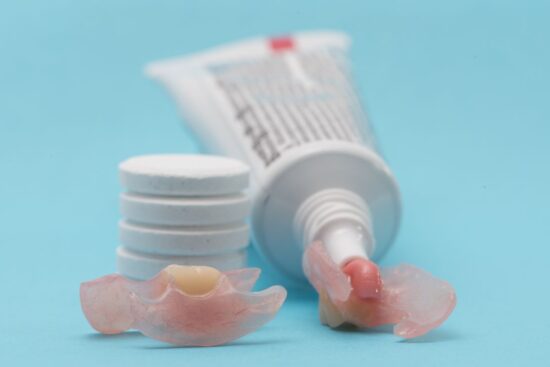
Whether you’ve just gotten a brand-new pair of dentures, or your older pair has begun to change shape, denture adhesive can help temporarily keep your prosthetics in place. Here’s a closer look at how these products work and why needing them may indicate it’s time to see your dentist.
Selecting a Denture Adhesive
With so many types of denture adhesives available, it can be confusing to know which type is best. The good news is that they all work very well, however which type you choose is often a matter of personal preference. Here’s a closer look at each.
Denture Adhesive Cream
Adhesive cream is very easy and convenient to apply, since it is premixed and simply squeezed from a tube. To use it, follow the steps below:
- Completely clean and dry your dentures.
- Apply the adhesive cream directly to the inside of your restoration in short strips, being careful not to get any on the edges or squeeze too hard, as this can cause adhesive to ooze out when you put the denture on.
- Rinse your mouth with water.
- Press the denture in your mouth, holding it firmly in place for several seconds.
Denture Adhesive Strips
Adhesive strips don’t require you to handle powders or figure out the right amount of cream and can be cut to fit exactly where they’re needed. To activate them, simply moisten with water. Here’s a look at how to use them properly:
- Fully clean and dry your dentures.
- Using clean, dry hands, remove the adhesive strips from their packaging, wetting each strip to be used with water.
- Attach one strip at a time, being careful to avoid the edges of the denture. Don’t overlap the adhesive strips.
- Rinse your mouth with water, press the denture into place, holding it firmly and biting down to secure the hold.
Denture Adhesive Powder
If you have dexterity issues, powder can be an ideal choice for. Because you don’t require much product, it can also be much more economical than other adhesives. To use:
- Clean your dentures well and rinse them but leave them wet.
- Spray the adhesive powder lightly and evenly on each surface that will contact your gums and the roof of your mouth.
- Moisten your mouth with water.
- Gently shake off any excess powder from the denture.
- Place your denture in your mouth, biting down on it to secure it into place.
Removing Adhesive from Your Dentures
Once you are done wearing your dentures for the day, you can remove them by swishing warm water in your mouth and gently pulling your prosthetics out. Place them somewhere safe and then brush your gums with a soft-bristled toothbrush and toothpaste to remove any excess adhesive from your mouth.
Then, using a second soft-bristled toothbrush, scrub your entire denture with mild hand soap or denture cleanser. Floss between each tooth and rinse your restorations well before submerging them in a glass of water or denture soak for the night.
If you find that your dentures have stopped fitting properly and you are relying on denture adhesive to keep them in place, it’s time to see your dentist. A reline procedure may be able to restore their fit, or you may need to upgrade to a new pair or a pair of implant dentures.
About Dr. Hinkle
Dr. Roth Hinkle was accepted to the prestigious Baylor College of Dentistry before he ever entered college! While there, he earned the General Dentistry Program Award, which is only presented to the top clinical students in the graduating class! He then earned his dental degree at the Texas A&M School of Dentistry in Dallas, the fifth highest ranked dental school in the entire United States. To schedule an appointment for dentures, please visit our website or call us today at (817) 481-4888.